Madison
|
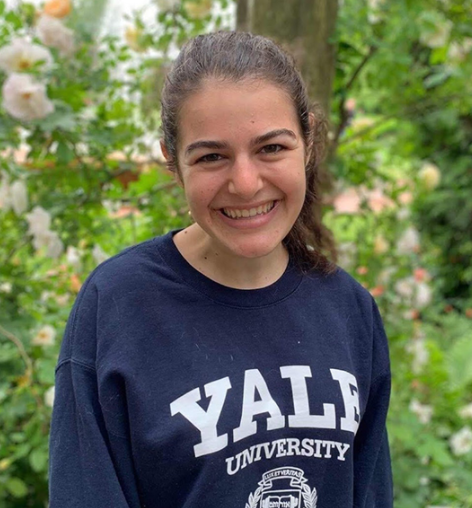
My name is Madison Hahamy. It kind of relates to who I am, the background on my last name. It comes from my dad’s side. It comes from “haham” in Hebrew, which means wise or knowledgeable. It has gone through a lot of different Americanizations. It was Hahamach at one point. Along with food, [my last name] is my biggest connection to my ancestry on my dad’s side, the fact that I say that word every day. I grew up with an interesting relationship with my last name because it’s so uncommon, I think we’re the only people in the world, so it really means my family, but it also has a really interesting history. It is a direct tie to this ancestor who was Bukharian who translated all of these books.
Favorite Jewish food: I’m gonna have to say Dushpara because I talk about it all the time and it is really good. Just the fact that it is such a unique food makes it something I’m more interested in because not that many people have heard of it. There are a lot of different ways to make it, but my grandmother makes it with ground beef filling and it’s these dumplings in a vegetable broth. It takes an incredibly long time to make, it takes entire days of cooking and preparation, so it is a special occasion kind of thing. |
|
Favorite Jewish holiday: I’ll go with Rosh Hashanah because it is the holiday my family is always together. I love the food on Rosh Hashanah. We always go downtown to my aunt and uncle’s place and our whole family gets together. My senior year of high school was the first time my synagogue let a girl blow the shofar and it was me, so I have a very exciting association with the holiday. It is the beginning of Chag and building up to the rest of the semester, which is really nice.
How would you describe your identity? Jewishly— I consider myself to be a quasi-observant Jew. I pick and choose what I observe. I sometimes keep Kosher, sometimes not Kosher. Sometimes I’ll abstain from technology on Shabbat, sometimes I won’t. It’s a buffet of Jewish rituals that I choose from. For me, I really tie my Jewish identity a lot to social justice initiatives and values more than actual ritual practices. I enjoy the ritual practices and sometimes they are meaningful to me— I like to think of Shabbat as an anti-capitalist act of resistance because you aren’t tied for your productivity for one day a week. But for the most part, I think more about values of saving one life and Tikkun Olam and service in the sense of protest, advocacy, and community organizing. That’s the part of my identity where I feel most Jewish. Can you talk more about something of the organizing and activism work you’ve done and how that ties to your Jewish identity? I’m currently involved with Serve the Moment, which is a Jewish social justice initiative. They are considered a direct service organization, but the organization I’m paired with is focused on education, advocacy, and equity. It has been nice to do work that isn’t explicitly Jewish, but is consistently supported by Jewish values. I was an organizing fellow at my college, worked on the campaign of a Jewish woman running for office in Wyoming, and protested with Never Again Action. Do you feel like your looks and experiences are included in the general picture of what a Jewish person is? I think that the social justice aspect is becoming a lot more widely known and mainstream. I think people are thinking of service as more all encompassing and addressing systemic issues. As a Bukharian Jew, that is not represented whatsoever. I got invited to a Facebook group after I wrote my article called Progressive Bukharians, and there are a lot of progressive Bukharians who are doing really cool work! They do exist, they’re just not as represented or amplified as I believe they should be. The frustrating thing is I don’t want to always be the one actively taking the initiative and putting in the effort to find people, I’d love it if things were widely available for me and so everyone else can learn about other types of Judaism and identities. |
"The frustrating thing is I don’t want to always be the one actively taking the initiative and putting in the effort to find people [like me], I’d love it if things were widely available for me and so everyone else can learn about other types of Judaism and identities." |
"When they talk about rituals, they talk about them in an Ashkenazi way. When they sing the cantillation, it is in the Ashkenazi way. When you do Shabbat, it is the Ashkenazi way. The foods at the Kiddish are Ashkenazi foods. Every single little thing adds up so much to the point where people don’t understand how much Ashkenazi culture is ingrained in every aspect of Judaism we practice." |
How does this affect your feelings about Judaism?
Yeah, 100%. I went through a phase right after my bat mitzvah— I think this is a common thing— where I hated Hebrew school and didn’t want to be there anymore. My parents let me drop out of Hebrew school, which forced me to come to terms with my Judaism myself. A lot of that happened through familial research and understanding where I come from. Also RTI was a huge help in that because it was the first time I realized you could be Jewish and do social justice things, that was never represented to me. When I started learning more about my family and the Bukharian aspect, and Mizrahi and Sephardi, I was feeling really left out of the Jewish conversation. It didn’t motivate me to do less. I didn’t see the representation, so I thought that everything I do something new, I am becoming the representation. In my college, it sucks that there are no other Bukharian Jews I know of, but I get to be the only one and that’s cool. It’s probably the wrong motivation because it kind of feels like spite, but it hasn’t deferred me from Judaism. It has made me want to be doing more so I could be the representation that I was missing growing up. What have been the most impactful ways for you to connect with your Bukharian heritage? Definitely food and genealogy because those are my real connections. My grandma can tell me stories as much as she wants, but they’re not things I grew up being able to experience. But I have this last name and this food that I eat once a month. Those are very tangible, direct things, so they seem more real than the stories she would tell me about speaking the dialect (Bukhori) or the clothes and songs. How have you seen Ashkenormativity manifest itself in Jewish communities that you’re a part of? Everything is Ashkenormative unless you go to a specific Sephardi or Bukarian synagogue. When they talk about rituals, they talk about them in an Ashkenazi way. When they sing the cantillation, it is in the Ashkenazi way. When you do Shabbat, it is the Ashkenazi way. The foods at the Kiddish are Ashkenazi foods. Every single little thing adds up so much to the point where people don’t understand how much Ashkenazi culture is ingrained in every aspect of Judaism we practice. At my Hillel right now, it is mostly Ashkenazi, but there are groups for Mizrahi or Sephardi Jews or Jews who are not Ashkenazi, so that has been really nice to have the outlet to talk about the ways our families practice. But even calling it “non-Ashkenazi” is inherently Ashkenormative too. It is really frustrating. The Judaism I learn about usually isn’t my Judaism, so it is a direct hindrance to me learning about my identity, family, ancestry, and traditions I might want to practice. |
|
Have you felt excluded from other spaces because of your Jewish identity?
Yeah. I think about this one a lot. I’ve never felt directly excluded, but I have at times felt uncomfortable. It’s not about my Jewish identity per se, but it is more related to my Israel-Palestine politics. I tend to kind of separate those two in my mind. For example, my school had a climate strike, and out of nowhere, the speaker brought up Israel-Palestine in a way that was really jarring and felt unnecessary. The way in which it was brought up made it feel like it was not the space for me and my beliefs. It made me realize that we need to do some coalition building and make sure they understand why saying things like that makes people uncomfortable. As I work through my own Israel-Palestine politics, it feels like those opinions are on blast while I’m still working through what I think. It’s a complicated topic. Do you feel like you’ve been able to find communities where your whole identity is accepted? “All aspects” is a big phrase. In progressive Jewish spaces especially, the Bukharian aspect of my identity is accepted wholeheartedly, but there is no Bukharian representation in the organization. It is accepted, but not necessarily raised up and actively amplified. It’s not that I feel uncomfortable, I’m just not the poster child. What do you think we could do as a larger Jewish community to make our spaces more welcoming for people who identify differently from the norm? One thing that my Hillel has done is they have so many groups that they actively amplify and give so much funding to. While the framing can be off— the fact that you have to join a group if you’re not Ashkenazi— having the space to do a Sephardi Shabbat or Mizrahi author reading groups is really impactful. In Hebrew schools, teaching the history of a lot more Judaism than just Eastern Europe is a start. It’s such a hard question because it is so deeply embedded in the way we think about American Judaism. There’s not one quick fix, it has to go all the way to the root of how we discuss Judaism and talk about history. It’ll take generations to do, but it starts with education and it starts now. |
" In progressive Jewish spaces especially, the Bukharian aspect of my identity is accepted wholeheartedly, but there is no Bukharian representation in the organization. It is accepted, but not necessarily raised up and actively amplified." |
"She told me that I had to be five times as good as all the guys when I blew the shofar because I was carrying this weight on my shoulders." |
You talked earlier about being the first woman to blow the Shofar on Rosh Hashanah. Can you talk more about how sexism has manifested itself in Jewish communities you are a part of?
At my synagogue, I can read Torah, and I have some Orthodox friends who were never taught that. We’ve never had a woman as a rabbi or cantor before. [With blowing the shofar], I was on the list for like six years, my mom would bombard them to get back to us. She told me that I had to be five times as good as all the guys when I blew the shofar because I was carrying this weight on my shoulders. No pressure or anything! These issues are indicative of larger systemic problems, so I don’t think it is a specific thing at my synagogue. I have yet to find a conservative or Orthodox synagogue that is fully accepting. I think you should be able to be more observant and find the level of acceptance that you find at a Reform synagogue. What is your favorite part about being Jewish? The people. I love Jewish people. All of my college friends just ended up being Jewish. Everyone I meet is so cool, fun, and funny. I’m so proud of us as a culture and an identity for all that we’ve been through and all that we’ve achieved in the world. I forget how small our community is! We’re really tiny, but we’re just everywhere! |
Click the links below to read articles Madison has written about her identity!
Discovering My Bukharian Jewish Identity
I Haven't Mastered my Savta's Dumpling Recipe Yet, But I'll Keep Trying
Discovering My Bukharian Jewish Identity
I Haven't Mastered my Savta's Dumpling Recipe Yet, But I'll Keep Trying
